Interior Lighting Project
Background
In the first major campus indoor lighting renovation in 20 years, crews from Johnson Controls, Inc. and Clinton Electric are replacing obsolete fluorescent lighting with new LED linear tubes and occupancy controls across campus in 33 academic buildings.
The transition to LED from fluorescent will reduce lighting power by 58% without reducing light quantity or quality. Occupancy sensors will automatically turn off lights in vacant spaces, reducing burn hours by 30% - 85%. Overall, the project is expected to save 4.8 million kWh of electricity annually, reducing the main campus electric district purchases by 7.4% compared to fiscal year 2026.
The project is 100% financed through a tax-exempt lease purchase and energy cost savings will be used to pay the debt service. The saved electricity will prevent the equivalent of 2774 metric tons of carbon dioxide emissions annually, which is equal to the yearly greenhouse gas emissions of 647 gasoline-powered passenger vehicles or the amount of carbon sequestered in a year by 2782 acres of US forests.
Buildings Affected
- Advanced Energy Institute
- Agriculture Building
- Allyn Building
- Altgeld Hall
- Anthony Hall
- Applied Sciences and Arts
- Davies Hall
- Engineering A
- Engineering B
- Engineering D
- Engineering E
- Faner Hall
- Forestry (Public Policy)
- Lesar Law Building
- Laundry-Applied Science
- Lawson Hall
- Life Science II
- Life Science III
- Lindegren Hall
- Micro Imaging and Analysis
- Morris Library
- Neckers Building
- Parkinson Laboratory
- Pulliam Hall
- Pulliam Industrial Ed
- Quigley Hall
- Rehn Hall
- Service Building II
- Shyrock Auditorium
- Student Services Building
- Wham Education Building
- Wheeler Hall
- Woody Hall
The project began in mid-June 2026 and will be completed in Q1 2027. Crews will transition to night shift, from 5:00 pm to 12:30 am, at the start of fall semester on August 17th.
If the lights in your area are not working properly, please fill out a Maintenance Request in our new service request portal. (You will be asked to login using single sign on, SSO.)
Hardware
Light Switches
Depending on the control system installed and the number of circuits in a room, one or more of these switches will be installed in the room, replacing old toggle switches:
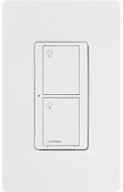
Top Button : lights on
Bottom Button: lights off
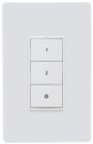
Button 1: Circuit 1 lights on
Button 2: Circuit 2 lights on
Power Button: Lights off
Occupancy Sensors
Depending on the control system installed and the shape of the room, one or more of these occupancy sensors will be installed in the room:
Ceiling Sensors:
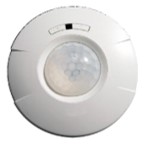
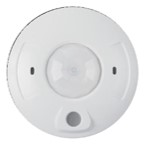
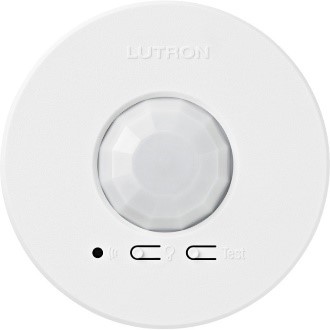
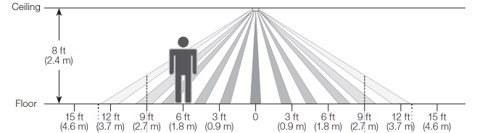
Typical Ceiling Sensor 360° view pattern:
Wall Sensors:
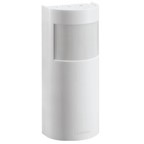
Typical wall sensor 180° view pattern. Hallway sensors can “see” up to 150 ft.:

These devices detect motion using passive infrared (PIR) sensors. The lens of the sensor is divided into many sectors that respond when illuminated with infrared light (heat emitted by warm objects). The sensors cannot see visible light and do not record images. When a person enters the view of any sector of the sensor, it registers this change and signals the control system that the area is occupied, starting a vacancy timer of 15-30 minutes. As a person moves across the view of the sensor, each change resets the vacancy timer to zero. When all the sensors in a room indicate vacancy, the system will automatically turn off the lights to save energy.
PIR occupancy sensors cannot “see” through objects or through glass. They must have direct line of sight to sense motion. The width of the sensor’s view sectors expands with distance, so the sensor can detect small motions up close but requires larger motions for detection from farther away.
Control Mode: Vacancy vs Occupancy
- Vacancy mode: By default, energy code requires most spaces, like offices and classrooms, to use vacancy mode, which means people must manually turn on the lights at the switch upon entering.
- Occupancy mode: Where switch access or safety are a concern, in spaces such as corridors, restrooms, library stacks, and laboratories, the controls will automatically turn lights on as soon as occupancy is detected.